HEAVIER COWS DONT JUST WEIGH MORE ON THE SCALES, THEY CAN WEIGH MORE ON THE BUSINESS.
Research shows that as mature cow weight increases, so does the energy required to maintain that animal. Maintenance demands account for 70–75% of a cow’s total energy requirements on average, and maintenance alone represents roughly half of all feed costs in a breeding operation (Ferrell & Jenkins 1984a, 1985). This means heavier cows consume significantly more metabolisable energy year-round, even before producing a kilogram of beef.
High mature weight also increases the change in liveweight required to shift body condition score. Larger-framed cows require substantially more weight gain to move one condition score than moderate-framed cows (Tennant et al. 2002). This makes it more difficult and more expensive to return larger cows to ideal condition postpartum, especially when feed quality declines or supplementary feeding is required.
The overall effect is well documented: excess mature cow weight drives up feed requirements, increases reproductive risk and reduces the efficiency of turning pasture into saleable kilograms of beef. However, larger cows produce larger, faster-growing progeny – meaning more saleable weight faster. So we have to balance the increased demand for feed with the higher sales revenue.
But beef production is not paid per kilogram of cow. It is paid per kilogram of progeny sold, per hectare, per year. For each system, there is a sweet spot to aim for, which considers:
-
Energy requirements/kg of cow bodyweight
-
Total energy required per head
-
Total kg of beef sold per hectare
Depending on the environment and feed quantity and quality, each enterprise will have an optimum cow size and therefore number of cows per hectare.
With this in mind, the ultimate goal is to achieve the highest final slaughter weight and the highest possible growth rate from cows whose maintenance requirements are in synergy with the environment and available feed.
MODERATING MATURE COW WEIGHT PRODUCES MORE BEEF PER KILOGRAM OF FEED
When feed availability varies and at times is scarce, moderating mature cow weight improves whole-herd efficiency by reducing the proportion of feed going into maintenance, the least productive use of energy in the beef system. When cows are moderate in size, a greater share of total dry matter intake shifts from maintaining big frames to supporting pregnancy, lactation and calf growth, the proper drivers of maternal productivity (Davis et al. 1983).
Because moderate cows have lower feed requirements (Laurenz et al. 1991; Ferrell & Jenkins 1984b), producers can run more cows on the same pasture base, increasing total calves weaned per hectare. Fertility also improves because smaller cows maintain body condition more easily, have shorter postpartum anestrus intervals and higher pregnancy rates (Houghton et al. 1990; Spitzer et al. 1995). The research is detailed: moderate cows rebreed more reliably and contribute more total kilograms of calf over their lifetime.
By keeping mature cow weight in a moderate range, producers may unlock more cows per hectare and more kilograms of beef per tonne of dry matter, because energy is spent on production rather than upkeep.
Moderating mature cow weight is not about making cows small. It is about ensuring they are efficient, fertile, and well-matched to the feed base. The science consistently shows that these cows produce more beef per hectare than herds trending upward in mature size.
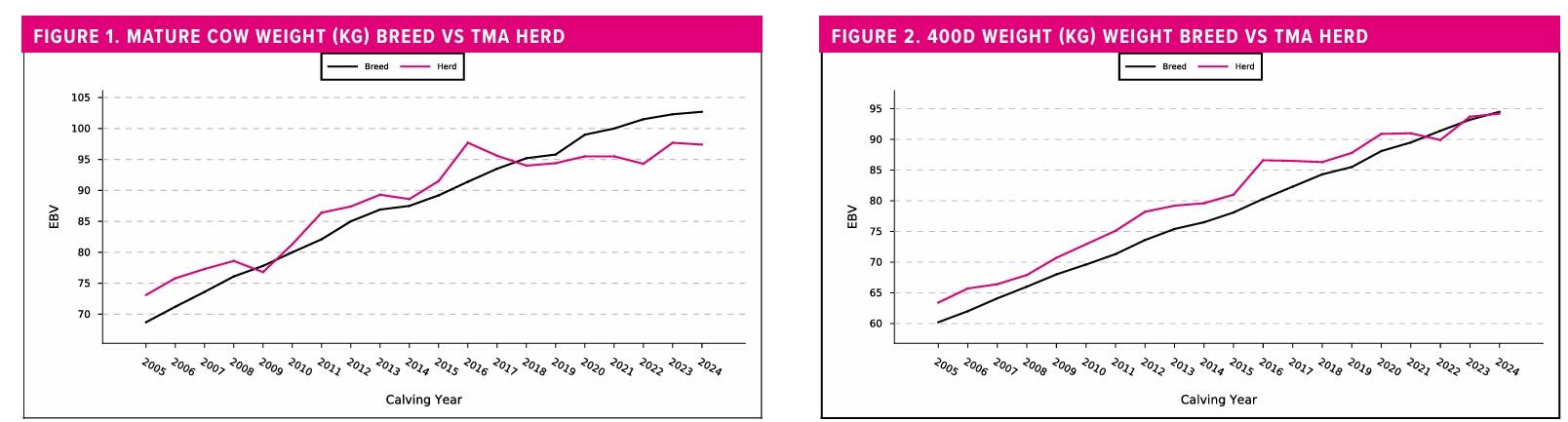
Te Mania Angus utilises a custom index, designed to select for improved enterprise profit across all traits. One breeding objective balances the benefits and costs of any increase in cow size. The index reflects that the industry is at a point where any further increase in cow size is likely to be offset by higher feed costs, outweighing any gains in sale weight.
Our index allows us to maintain cow weight within a sustainable zone, whilst also increasing an enterprise’s sale weight and bending the growth curve, improving the overall economic impact of cows bred from Te Mania Genetics.
By Edward Gubbins, Te Mania Angus