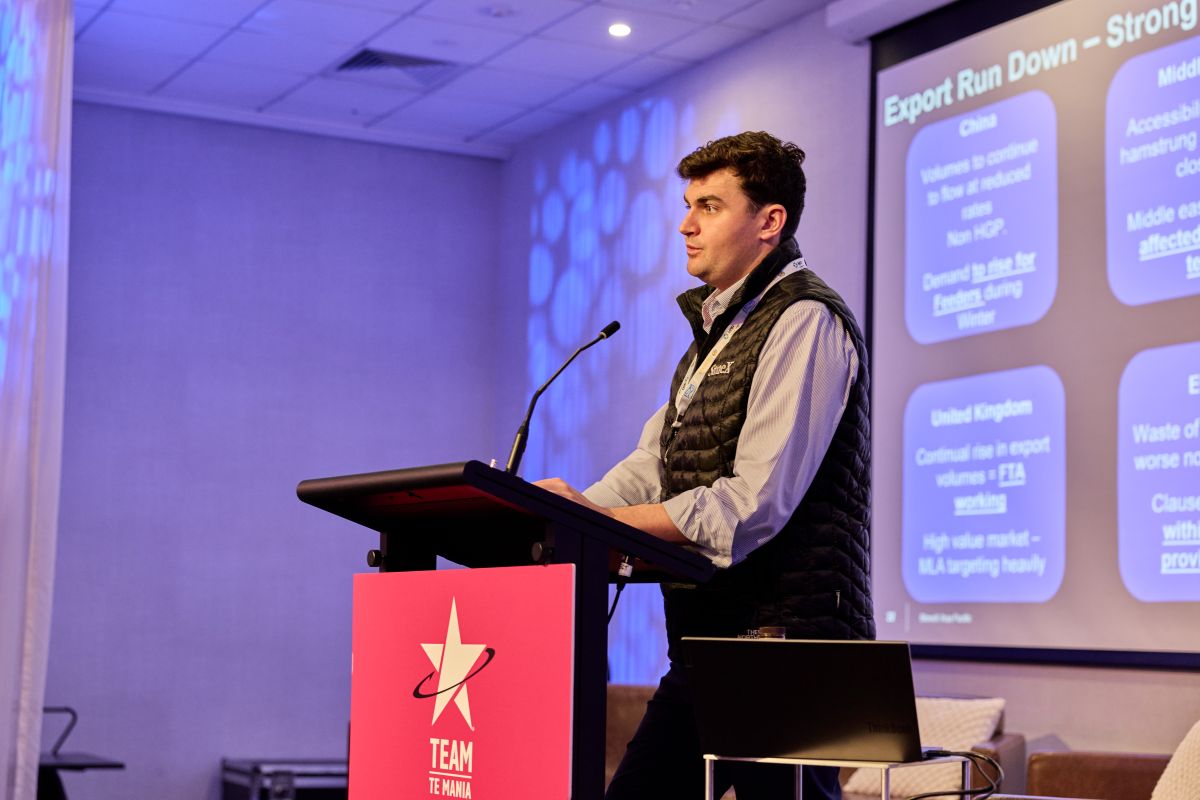
Ripley Atkinson, Australian Meats & Livestock Manager at StoneX joined the 2026 Team Te Mania Workshop in Echuca- Moama and shared insights on the Australian beef market outlook, examining the key fundamentals, volatility, and uncertainties shaping the industry over the next 12 months.
Drawing on market data and his on-farm experience, Ripley discussed the impact of climatic challenges and opportunities, domestic supply pressures, and ongoing geopolitical and trade access uncertainty, while also outlining potential approaches to navigating risk through forward contracting and risk management strategies.
________________________________________
Australian Beef Industry Market Outlook: Fundamentals Sound, Uncertainty Aplenty
Fundamentally, Ripley Atkinson reckons beef producers have it all down pat – with the quality and the numbers to meet demand.
But the StoneX Australian meat and livestock manager also knows an industry operating under a cloud of market volatility – not helped by even more volatile geopolitics – must have options.
And that, he told the Team Te Mania ‘navigating the next frontier – the new breeding intelligence’ in Moama, NSW, means producers need to cover their proverbial hindquarters.
Ripley said those producers are riding a strong outlook, where global demand for Australian beef is high and the national herd’s cycle “is optimal” in relation to major competitors such as the US and Brazil.
He says buyer demand from feedlots and processors is strong but that also means feedlots are at historically high capacities.
“So their ability to increase that capacity is a serious unknown and unknowns add to the uncertainty,” Ripley explained
“From there processors seeing record throughput also face the challenge of meeting those production levels,” he said.
“The potential solution here for producers are the first forward contracts for beef cattle, managing potential price volatility exposure through the fixed nature of those contracts.
“StoneX has created them to protect the grower margins and let them better manage price volatility.”
Ripley says like forward contracts offered across the agricultural range, the StoneX feeder cattle opportunity lets producers make better long-term financial plans.
He says producers can pick a price with which they are comfortable and it gets locked in – then the cattle just need to be delivered to the contracted feedlot’s specifications.
Operating 12 months out, the contracts are normally part of the marketing strategy, with producers hedging part of their production and keeping the rest for the spot market.
“Livestock producers, like all farmers, have a challenge at both ends of the production chain – they have to work with, and manage, seasons and then manage what they are going to get for all their hard work,” Ripley says.
“With the forward contract, which is with feedlots, the producer knows exactly what the delivery grid is, and can focus on achieving that without the worry of what the return will be,” he adds.
“The contracts are a new product for us, and the only one in the market for livestock, and we have found the processors and feedlotters are very comfortable working with them. Now we need livestock producers to see what’s in it for them as well.
“They fit any red meat production and whether you are turning off 100 head, or 15,000, scale is not an issue and the more we get this product into the marketplace the better the outcome for users as more competition creates better outcomes.”
Written by Andrew Mole, Picture by Emily McCormack.
________________________________________
More details:
Ripley Atkinson, StoneX Australian meats and livestock manager at Ripley.Atkinson@StoneX.com or 0427 417 803.
Hear more from Ripley at: https://mc-5dc23f93-43d0-491b-9a0f-708421-cm.azurewebsite…